
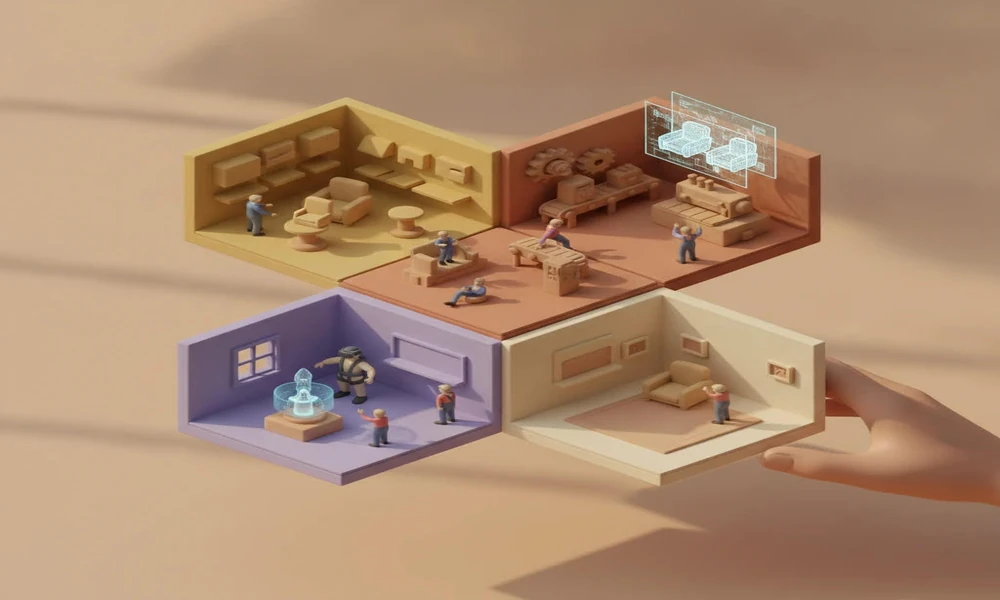
- Pre-rendered 3D plays the same way every time. Real-time 3D responds to the user, and that response is where the value sits.
- In commerce, the win is letting shoppers resolve their own doubts about size, fit, and look, which can mean fewer returns.
- Digital twins stay linked to the live system, so teams can test and predict before touching the real asset.
- Simulation training works, but fidelity is a budget choice and skill transfer should be tracked, not assumed.
- Judge a build partner on performance on the real target device, on integration, and on maintenance, not on a demo reel.
A product lead signs off on “a 3D version” of the flagship product. In their head, they picture a slicker promo video. What lands instead is something that behaves. A customer can spin it, open it, swap the finish, and drop it into their own room. The budget meeting treated this as a render. It was always a decision tool.
That gap matters, because real-time 3D applications have quietly moved out of games and into everyday business work. The question a buyer should ask is not “does it look real?” It is “what does this let someone do?”
Here is the blunt version. Render speed is table stakes now. Interaction is the value.
A static photoreal render is just a nicer photo. It answers no new question. The moment a person acts on the model, rotates it, tests it, rehearses with it, real-time 3D technology does something a video never could. This piece maps where that value actually shows up across sales, operations, training, and customer experience, and how to judge a build before you pay for one.
Real-time 3D applications earn their keep by responding, not by rendering
Start with the real difference. Pre-rendered graphics and video are a fixed sequence of frames. Someone decided every frame in advance, and it plays the same way every time. Real-time 3D builds each frame on the spot, in response to what the user does right now. Rotate it, zoom in, open a panel, walk through a space, change a setting, and the scene recomputes live. That responsiveness is the whole point.
So visual quality is the floor, not the edge. Every serious engine renders well on target hardware today. What sets one real-time 3D application apart from another is what the user gets to do inside it.
That does not mean render speed is easy. It means it is a solved discipline that still has to be engineered on purpose. Performance problems can land on either the CPU or the GPU, and the fix for a CPU-bound bottleneck is not the same as the fix for a GPU-bound one. A good team treats frame speed as a real constraint and plans for it. It is not an afterthought. But once it is handled, it stops being the thing that wins the work.
This is no longer a niche. The global 3D digital asset market was valued at about USD 32.47 billion in 2025 and is projected to reach roughly USD 98.21 billion by 2034, with adoption spread across media, architecture, healthcare, retail, and manufacturing. That spread tells you something simple. 3D business applications are now core infrastructure, not a gaming novelty.
So where does the “value is in the verb” idea actually pay off? Four places. Take them in turn.
Real-time 3D visualization turns a product page into a decision tool
A shopper online cannot pick the thing up. Their real worry is fit, size, scale, and whether it will look right in their space. A flat photo leaves them guessing. Guessing is where carts get abandoned and returns get created.
Real-time 3D visualization closes that gap. Three use cases carry most of the weight:
- Configurators that let a shopper change color, material, and size and see the result update live.
- Zoom-and-rotate views that show the product from any angle.
- Buy-before-you-build previews that place the item in a real setting.
This is the moment 3D product visualization becomes interactive 3D visualization. The shopper explores and answers their own questions, instead of being shown a single staged shot.
Why does it work? By mechanism, not magic. It gives shoppers more information before they buy, removes guesswork about size, scale, and appearance, and can lower returns by setting more accurate expectations. Those are the reasons, and they hold up on their own. They are not a promise of a specific sales number.
One named result is worth stating carefully, as that one brand’s experience. Rebecca Minkoff, a Shopify merchant, reported that shoppers who viewed products in AR were 65% more likely to make a purchase, and those who viewed 3D models were 44% more likely to add the item to their cart. That is one brand’s reported outcome on its own product pages. It is not a universal lift you can bank on, and nobody should sell it as one.
Here is the decision that follows. Your build brief should start from the doubt the shopper is stuck on, not from how glossy the model can look. If the configurator does not resolve a real question, the fidelity is wasted spend. A custom-built real-time 3D product experience earns its cost by removing a specific hesitation, every time.
Interactive 3D applications let operations teams test the change before they touch the asset
In operations, real-time 3D is a rehearsal space. The clearest example is the digital twin.
A digital twin is a synchronized virtual model that helps a business represent, diagnose, predict, and optimize its operations. It keeps a two-way, continuously updated link to the physical system. So it reflects the plant or the machine as it actually runs right now, not as it looked last quarter.
That live link is the dividing line. A plain simulation imitates a process, but it is not fed by real data from the physical asset. A digital twin stays connected both ways. That connection is what makes it interactive 3D applications territory, rather than a nice model sitting on a shelf.
The benefit, in the standards body’s own words, is practical. Digital twins can help increase production, improve product quality, and reduce manufacturing costs. Worth stating plainly, and worth not inflating into a guaranteed return.
Picture what a team can do with one. They can walk a modeled plant floor. They can test a layout change before moving a single machine. They can rehearse a maintenance sequence, or predict where a bottleneck will form, all before anyone shuts a line down. The twin is worth its cost because people do things in it. Not because it looks like the factory. This is one of the clearest places where responsiveness, not render quality, carries the value of 3D business applications.
Real-time 3D experiences let people practice the costly mistakes safely
Some procedures are dangerous, expensive, or rare. An emergency shutdown. A surgical step. A confined-space entry. You cannot hand those to a new worker and let them learn by failing on the live system. The cost of a real mistake is too high.
Real-time 3D experiences give a safe place to fail, repeat, and build the muscle memory. The responsiveness is the point. The trainee acts, and the system reacts, which a training video simply cannot do.
The evidence here is encouraging, and it comes with honest limits. In a 2020 review of simulation-based surgical training, training with a simulator produced better performance than no training or lecture-only training. Two caveats belong in the same breath. Low-fidelity simulators matched expensive high-fidelity ones in 15 of 17 studies, so more realism is not automatically more learning. And only 3 of 17 studies tested trainees on real patients afterward, so the direct skill-transfer evidence is still thin.
Those caveats carry a design lesson. Fidelity is a budget decision, not a given. Spend realism where it changes behavior, and skip it where it does not. Then measure transfer with tracked KPIs rather than assuming the simulation caused the on-the-job result.
That honesty is what keeps this credible. When you tie immersive business applications to L&D, connect them to numbers the team already follows: error rate, time-to-competency, incident counts. Watch those move, or do not claim the win. Simulation-based and game-based training is a strong tool, but it is a tool you measure, not a promise you make.
3D interactive experiences win when they do a real job, not when they dazzle
Now the customer-facing side. Virtual showrooms, web-based 3D viewers, and AR and VR features all extend a brand past flat photos and video. Call them 3D interactive experiences. They can be real 3D digital experiences that pull a customer in.
Here is the trap, stated directly. Most immersive brand projects fail because they chase a “wow” instead of a task. A showroom nobody can buy from. An AR gimmick with no purpose. These get one look and no return. That is a mistake, and it is an expensive one.
They work when the interaction answers a question the customer actually has. Place the product in their room. Try a configuration. See the inside. The verb is the value, the same rule that held in commerce and operations.
One attributed example makes the point. Oakywood, another Shopify merchant, described its AR model as a post-purchase “game changer” for helping customers place the product in their own space. That is one brand’s account of what worked for it. Read it as a useful example, not as a rule that will repeat for everyone.
So before you commission a showroom or an AR feature, name the one job it does for the customer. If you cannot name it, you are buying spectacle.
Judging real-time 3D solutions comes down to performance discipline and fit
Last, how to commission the work. Off-the-shelf 3D viewers are fine for simple, standalone needs. Serious business applications usually get custom-engineered, and for good reasons. They have to fit existing processes, data, and platforms. They have to feed and read from live systems. And they have to keep working as those systems change. No generic viewer handles all of that.
Performance discipline is where many builds quietly fail, and it ties straight back to the stance. Real-time 3D must run on the customer’s actual device. So a good partner profiles the application on its chosen release platform to get realistic numbers, rather than trusting what the editor reports. The editor shares its own process and only approximates the real thing. “It ran fine on my laptop” is not a performance claim, especially when CPU-bound and GPU-bound bottlenecks need different fixes.
When you weigh real-time 3D solutions, look for a short, plain set of signals in a partner:
- Target-device profiling from day one, not at the end.
- A clear plan for integration with your existing data and platforms.
- Honest fidelity choices tied to the job, not maxed out by default.
- A maintenance plan for the full life of the asset.
Custom work often lands on an engine built for interactive, real-time response, such as Unity. The reason is simple. That tooling is built for exactly the live-response problem that makes these applications valuable in the first place. Commissioning a capable Game Development Company India is less about the demo and more about that engineering discipline.
Which is the real test. Do not buy on the demo reel. Buy on whether the partner can make the interaction run, and keep running, on the device your user actually holds. That is where real-time 3D applications succeed or fail.
Commission the interaction, not the render
Across sales, operations, training, and customer experience, the thing that made real-time 3D worth the money was never the render. It was what the user got to do.
So scope your next project from the other end. Start with the decision or the task you want to enable. Then spend on fidelity only where it changes what the user does. Render speed is the price of entry. Interaction is the return.
Write down the one job your 3D has to do. Then judge every proposal against it. That single sentence will tell you more than any demo reel.
FAQs
What is the difference between real-time 3D and a pre-rendered video?
A pre-rendered video is a fixed sequence of frames that plays the same way every time. Real-time 3D builds each frame on the spot, in response to what the user does. That is why you can rotate, zoom, and change things live.
Is real-time 3D only for big companies?
No. Adoption now spans media, architecture, healthcare, retail, and manufacturing, across firms of many sizes. The right question is not company size but whether the interaction solves a real problem.
What is a digital twin, in plain terms?
It is a live, two-way synced virtual model of a physical system. Because it stays connected to the real asset, teams can diagnose, predict, and test changes before touching the actual equipment.
Does more photorealism mean better training?
Not automatically. In the reviewed surgical studies, low-fidelity simulators matched expensive high-fidelity ones in most cases. Fidelity is a design choice, so spend it where it changes behavior.
How do I know if a 3D build partner is any good?
Look for target-device profiling from the start, a real integration plan for your data and platforms, and a maintenance plan for the life of the asset. Judge them on that, not on the demo reel.

Comments are closed.